

Ground shaking scenarios fall within the deterministic framework. They provide physically consistent estimates of seismic motion generated by one or more well-identified seismogenic sources, at specific sites or across a region.
Scenarios are widely applied for:
- ground-motion reconstruction of past earthquakes and prediction of future ones,
- seismic risk assessment,
- emergency planning and civil protection strategies.
Why do they matter?
Reconstruction of past earthquakes
Available geological, seismological, and instrumental data are combined to reproduce the shaking caused by historical events. This information includes instrumental recordings, macroseismic observations, characteristics of active faults, wave propagation models, and local geotechnical properties. By integrating these elements and applying source and ground-motion propagation models, it is possible to simulate ground behavior during the event, generating synthetic seismograms and maps of shaking parameters (such as peak acceleration, velocity, and intensity).
Prediction of future earthquakes
Specific seismogenic sources, identified based on geological, geophysical, and historical knowledge of the region, are assumed to be capable of rupturing. Since the rupture parameters of each source (e.g., stress drop, rupture velocity, nucleation point) are uncertain, multiple rupture configurations are explored through numerical modeling and stochastic simulations. This approach produces a set of scenarios representing a range of possible realizations of the event, with different spatial distributions and levels of shaking intensity.
What are the modeling approaches and techniques?
Scenarios are typically represented as (Figure 1):
- maps of ground shaking parameters, such as Peak Ground Acceleration (PGA), Peak Ground Velocity (PGV), or response spectral ordinates;
- synthetic seismograms, i.e., time series of ground motion at selected sites.
The essential components of any scenario include:
- Seismic source – fault geometry and rupture parameters (magnitude, focal mechanism, stress drop, maximum slip, rupture velocity).
- Propagation medium – 1D, 2D or 3D crustal structure and rheological properties (seismic velocities, density, attenuation).
- Local site response – amplification and waveform modification due to near-surface geology.
- Ground Motion Models (GMMs)
They are empirical predictive models that estimate key measures of ground-shaking intensity based on parameters describing the earthquake and local site conditions. These models are developed through statistical regression analyses of recorded earthquake datasets and account for variables such as event magnitude, source-to-site distance, fault mechanism, and local geological and geotechnical conditions (site effects).
Recent advancements move beyond the traditional ergodic assumption, incorporating regional and site-specific effects to produce more realistic and spatially consistent ground-motion estimates.
2. Stochastic simulations
They generate synthetic seismograms using statistical representations of the source, path, and site, introducing randomness to reproduce the observed variability of ground motion.
3. Numerical simulations
The most advanced simulations are based on 3D models of seismic wave propagation, often implemented on high-performance computing (HPC) (Figure 2) infrastructures. Examples include: Physics-based simulations, which solve the full elastodynamic equations to explicitly represent seismic rupture processes and 3D wave propagation (Figure 3). Notable examples are the CyberShake (SCEC Cybershake | Southern California Earthquake Center) and SPEED (The Project – speed), which enable broadband modeling of moderate-to-large magnitude earthquakes.
- Hybrid simulations (e.g., the HIC – Hybrid Integral-Composite code), which combine deterministic effects at low frequencies with stochastic variability at high frequencies.
- Kinematic rupture simulations, which prescribe the evolution of fault slip (slip distribution, rise time, rupture velocity) through parameterized models, allowing efficient broadband modeling without solving the full rupture physics.
- Dynamic rupture simulations, which directly model ground motion based on physically consistent rupture processes, producing realistic broadband seismograms.
The Scenario Earthquake
A fundamental step in scenario development is the selection of the reference earthquake, i.e., the most representative or worst-case event for a given site or region. This choice is guided by:
- hazard disaggregation at the site,
- geological evidence of active faults,
- historical seismicity,
- seismotectonic and geodynamic context.
Explore Our Scenarios
Interactive examples are available online:
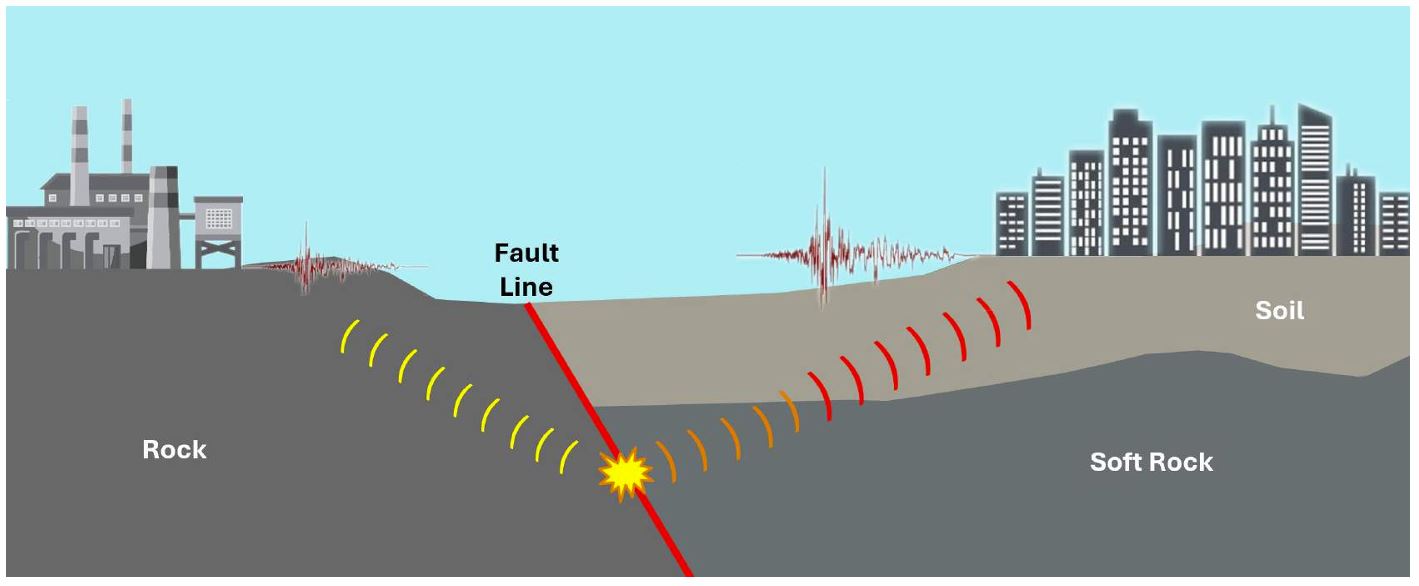
Figure 1 – The ground motion recorded at the surface results from the combination of three main factors: source effects (rupture process and fault characteristics), wave propagation (geometrical spreading, attenuation, and scattering along the path), and site amplification (local subsurface properties and stratigraphic resonance effects).
To generate them, complementary approaches are employed:
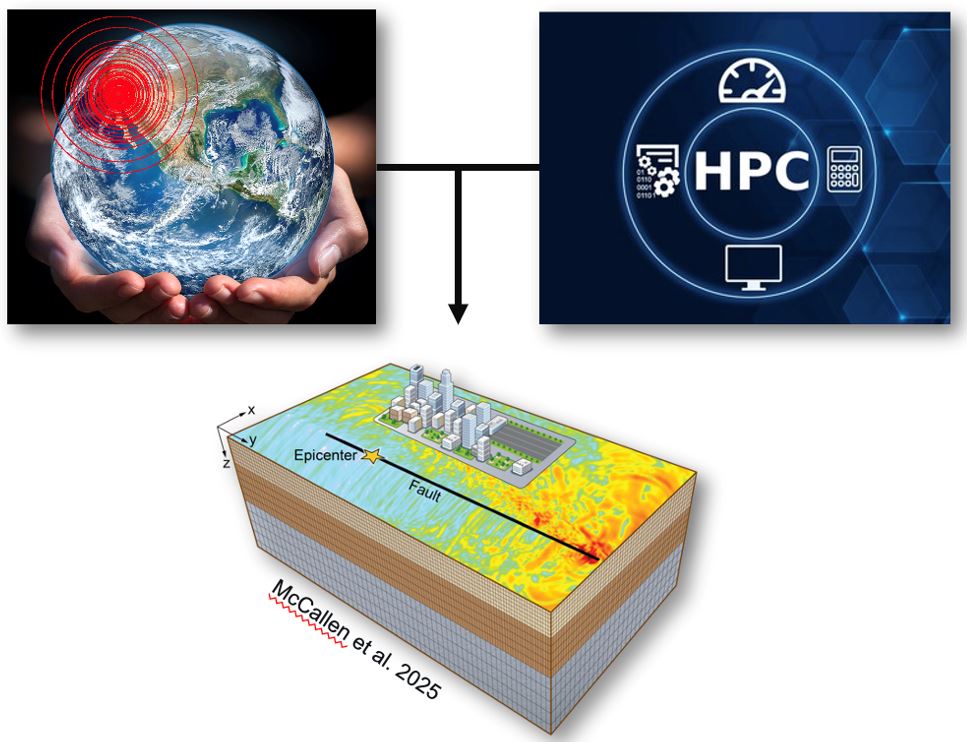
Figure 2 – The seismic process is modeled through 3D numerical simulations of wave propagation, performed on high-performance computing (HPC) infrastructures, enabling detailed reproduction of ground motion in complex geological media.
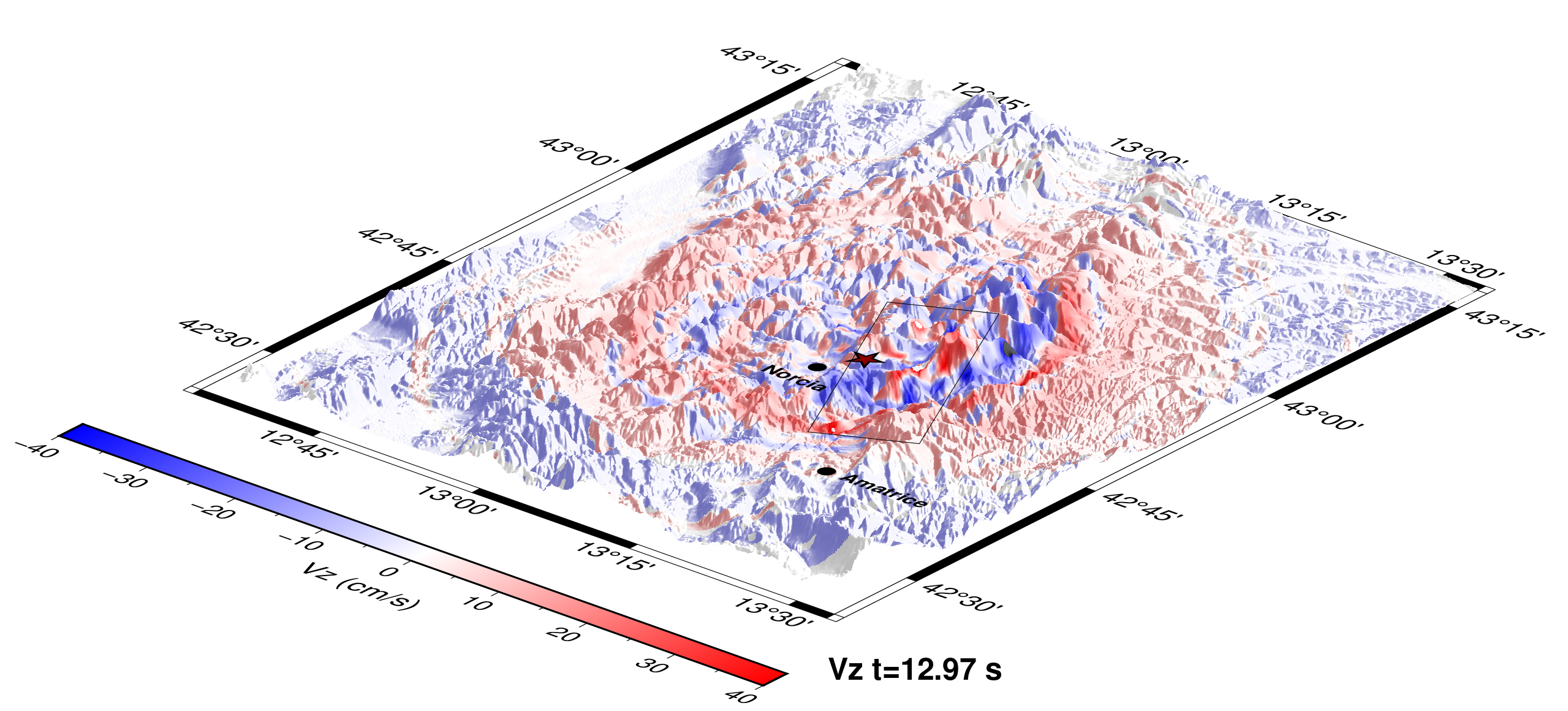
Figure 3 - SHAKEMOVIE: three-dimensional simulation of the propagation of seismic waves generated by the 24 August 2016 Amatrice earthquake (M6.2). Blue areas represent ground motion moving downward, while red areas indicate upward ground motion. The color intensity increases with the velocity of the vertical displacement. The propagation and amplitude of seismic waves are controlled by the characteristics of the earthquake source, the geological properties of the materials they travel through, and the local topography.